
Tim Hill’s career has been full of ups and downs. He was selected in the 32nd round (963rd pick) of the 2014 MLB draft by the Royals out of Bacone College in Oklahoma, an NAIA1 school with about 260 undergrads enrolled yearly. The lefty was a solid prospect, posting a 17-5 W-L record, a 2.12 ERA, and 102 strikeouts in two years at Bacone. However, because of his level of competition and lack of coverage at the NAIA level, he had to wait until the 32nd round to hear his name called. His major league career has been no short of waiting either; he waited until 2018, his fourth year in the organization, to be called up to the big leagues, and after a two-year stint in KC, he was dealt to the San Diego Padres. Hill was a staple in the Padres bullpen for four more seasons, pitching in their 2020 and 2022 playoff runs. Yet, Hill’s time in San Diego ended on a sour note, with four IL stints and a down season in 2023 leading the Padres to part ways. Hill then signed with the White Sox, and after pitching to 5.87 ERA and the team boasting an abysmal 17-52 record, he was designated for assignment and later released. The White Sox ended the season 41-121, the worst record in MLB history.
While the White Sox’s record will live in infamy, Hill’s story is less about their failure and more about his rebound. He signed with the Yankees eight days after his release, and never looked back. In 35 games and 44 innings for New York in 2024, Hill posted a 2.05 ERA, aided by the best groundball rate in all of MLB, at 69.9%. He also led all of baseball in missing batters’ barrels, at 1.7%. He is elite in these two metrics mostly because of his unorthodox -20° submarine arm angle, and his sinker.
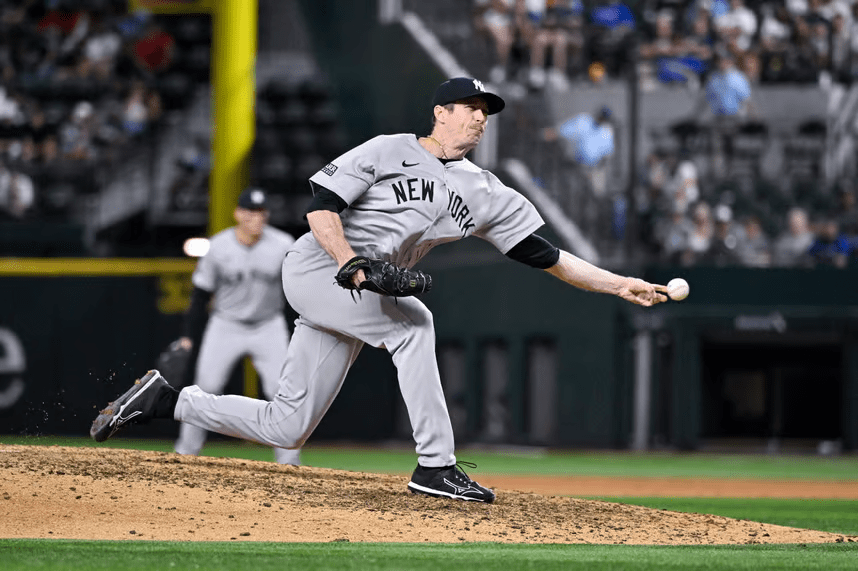
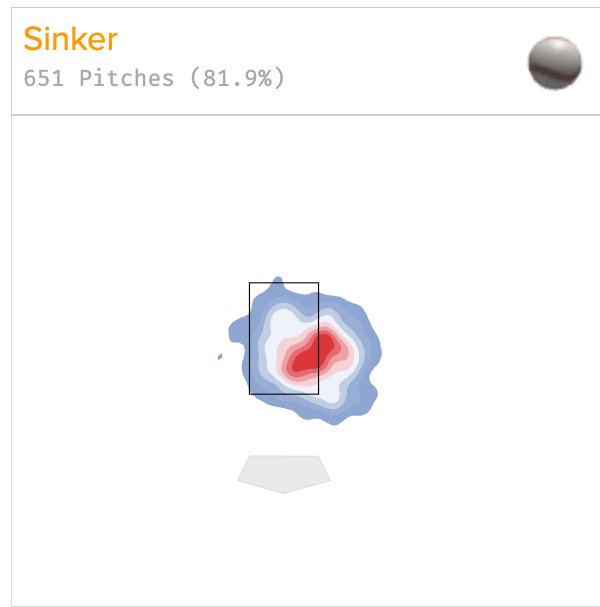
Hill throws the pitch just over 80% of the time, and mostly on the inside part of the plate, giving left handed hitters close to no chance to put a good swing on it.
Last October, Yankees pitching coach Matt Blake compared Hill to former Yankee reliever Wandy Peralta:
“A trustworthy, strike-throwing lefty that can match up and get lefties on the ground … we feel really good about him coming in, throwing the ball over the plate and putting guys on the ground in some high-leverage spots.”
That trust was reflected in the Yankees’ decision to re-sign Hill even at age 34, cementing him as the premier left-hander in their bullpen. What stands out most is that last part — high-leverage. It’s one of the biggest elements of Hill’s resurgence, and a role the Yankees have increasingly trusted him with. Hill was dominant in the 2024 playoffs, pitching to a 1.08 ERA in his 10 chances in October. This led to his high-leverage, left-handed specialist spot growing in 2025. In his 11.1 high-leverage innings this season, Hill is keeping batters on the ground at a 66.7% clip, and has posted a 2.59 FIP2. A great example of Hill’s value was on full display Tuesday night, when he came in with the bases loaded to face one of the best young stars in baseball today, James Wood. After a 6 pitch battle, Hill forced Wood to ground out in what would be the most important at-bat of the game.
While Hill is by no stretch the best pitcher in baseball, his journey from being cut by the worst team in history to thriving in high-leverage spots for the Yankees is a testament to resilience, reinvention, and the Yankees’ knack for developing pitchers, even at the tail end of their careers. Hill will continue to pitch in the Bronx and likely be the first option to face left-handed hitters out of the bullpen. For a reliever once left behind, he has undoubtedly found new life in the Bronx.
- NAIA stands for the National Association of Intercollegiate Athletics, a governing body for college athletics at smaller institutions. The NAIA is often considered comparable to the NCAA’s Division II level. ↩︎
- Fielding Independent Pitching (FIP) and is a statistic that estimates a pitcher’s effectiveness by only considering the outcomes a pitcher directly controls: home runs, walks, strikeouts, and hit batters. It removes the influence of the defense and luck on batted balls in play to provide a more stable measure of a pitcher’s true skill, using a league-specific constant to scale the results to an ERA-like number. ↩︎

 The Yankee Office
Leave a comment