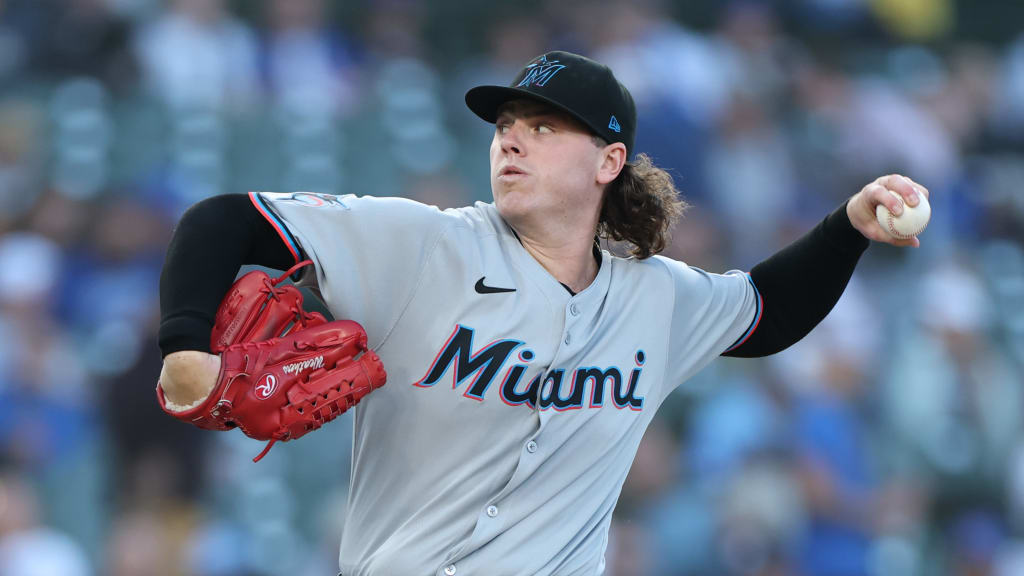
After what has been a quiet and frustrating offseason for Yankees fans, YES Network insider Jack Curry announced Tuesday night that the team is acquiring left-handed starting pitcher Ryan Weathers from the Miami Marlins.
The Yankees have been no strangers to trade talks with Miami this winter. Just a week ago, reports surfaced that New York was in the mix for young flamethrower Edward Cabrera. However, Cabrera was dealt to the Chicago Cubs, and New York Post insider Jon Heyman later reported that the Yankees were “never close” to finalizing a deal for Cabrera.
With the bigger-name Cabrera off the board, the Yankees shifted their focus and landed Weathers, a move that may not grab many headlines but carries intriguing potential for the pitching staff in 2026 and beyond.
Weathers has carried buzz around his name since his high school days, as he put up mind-boggling numbers at Loretto High School in Tennessee. As a senior, Weathers pitched to an 11-0 record, with a microscopic 0.09 ERA, striking out 148 batters in 76 innings. The left-hander did all of this while batting .434 at the plate. These numbers earned him the 2017-2018 Gatorade National Player of the Year award and made him the seventh overall pick in the 2018 MLB Draft by the San Diego Padres.
Weathers’ high school stats only got him so far in San Diego, however. Despite debuting on the biggest stage in the 2020 NLDS — and rising as high as No. 5 in MLB.com’s Top 30 Padres prospects list — the lefty struggled to find consistency in San Diego, posting a 5.73 ERA in three seasons. With plenty of pitching depth in San Diego’s system and Weathers’ poor performance, he was dealt to the Marlins at the 2023 trade deadline.
Since 2024, though, Weathers has begun to turn a corner. In 24 starts across the past two seasons, the left-hander pitched to a 3.74 ERA while holding opponents to a .236 batting average against. In 2025, Weathers saw his fastball tick up to an average of 96.8 MPH — topping out at 99.2 MPH — good for 86th percentile among MLB pitchers.
While his fastball lights up the radar gun, Weathers’ secondary pitches should also draw plenty of intrigue from Yankees Pitching Coach Matt Blake. Weathers’ sweeper, while not elite in movement metrics, produced great results in 2025. Opposing hitters managed an expected batting average of just .172 against the pitch, and swung and missed at a 39% rate. His changeup is even better. Thrown roughly 30% of the time and often tunneled1 with his fastball, the pitch generates an average of 33.3 inches of vertical drop, holding hitters to an expected batting average of .214 with a 40.6% whiff rate.
The biggest concern surrounding the acquisition is Weathers’ durability. The 26-year-old has already experienced five IL stints, with two notable injuries in 2025. Early in the season, Weathers suffered a left flexor strain that sent him to the 15-day IL. Later, he suffered a left lat strain — the same injury that sidelined Yankees’ right-hander Luis Gil for much of 2024 — placing him on the 60-day IL. Weathers finished the year with just eight starts and an ERA approaching four.
Ironically, the Yankees will be using Weathers to help fill their own injury-related absences. With both Gerrit Cole and Carlos Rodón expected to miss time early in 2026, Weathers is likely to slot into the rotation for at least the first two months of the season — health permitting.
Weathers’ father, David Weathers, also pitched for the Yankees during the 1996 and 1997 seasons.
All in all, the Weathers deal brings much more upside than risk for New York. While the durability remains a significant question mark, the Yankees are betting on improved health, refined secondary pitches, and the guidance of Matt Blake to unlock the former top prospect’s potential. In the short term, Weathers provides much-needed rotation depth while New York navigates early-season injuries. In the long term, with three years of team control remaining, Weathers represents a low-cost, high-reward arm who could play a meaningful role in the Yankees’ pitching plans beyond 2026. For a fan base waiting on action this offseason, this is a move that could quietly pay off.
- Pitch tunneling is a strategy where a pitcher throws different pitches (like a fastball and changeup in this case) along the same trajectory out of their hand for as long as possible, making them look identical to the batter until the last moment. The goal is to delay the hitter’s ability to identify the pitch, disrupting their timing by disguising secondary pitches within the fastball’s path ↩︎


 The Yankee Office
Leave a comment